Preparing for Biblical Education
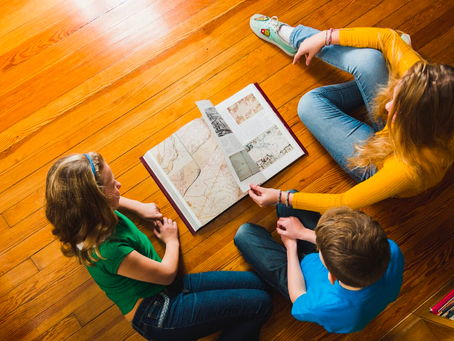
Are you starting to plan your children's education for the new year? Then, don't forget to include the Bible. In 2 Timothy 3:16, we read that the Bible is useful for all kinds of teaching. Below, we will share some ways to use it in our children's education.
Character Development – The beginning of the day is the best time to read Bible stories that will motivate them to develop good character traits. After reading and praying with them, pray for them throughout the day so that the Holy Spirit brings to their minds concepts that will help them resolve difficulties or make correct decisions.
To teach good character traits to children, you can use the free lessons from Sonlinght Brasil.
For older children, you can use the Bible itself or a devotional appropriate for their age.
Throughout the day, when a problem arises, also take the opportunity to remind them of stories of biblical heroes and how they faced their problems. The workbook How to Teach with the Bible has a very extensive list of suggestions.
In addition to character development, the Bible also improves human intellectual development. Scientific research has already proven that studying the Bible has the power to expand mental capacity and improve neural connections.
Academic Teaching – Before introducing a new topic or chapter, consider what the Bible says about the subject and present it to your child. You can tell a story or parable related to the topic, and if no specific text comes to mind at the moment, do a internet search with a keyword. Don't forget to pray, and the Holy Spirit will enlighten you.
- Portuguese Language – The rich language of the Bible develops a noble and elevated language. Grammatical concepts can be taught using the Bible. (e.g., Verb: John 1:1, 2). See also the Grammar in the Bible.
- History – The Bible presents universal history; by relating the study of history to biblical chronology, the child will grow with a worldview filtered through God's Word. And since it has the potential to expand brain capacities, it will make learning memorable.
- Geography – The biblical story geographically begins in Eden, in the Middle East, and expands to Europe (by Paul's time). When reading biblical stories, always associate the mentioned location with its current place on the map, and this will expand your child's knowledge and faith.
- Science – The Bible is incredibly rich in scientific information. In Genesis 1 alone, we see the principles of all created things (physics, geography, botany, astronomy, sociology, anthropology, etc.). In the book of Job, chapters 36-39, we find incredible details about natural sciences, and in Leviticus, health laws that are demonstrably relevant even today.
- Mathematics – Beyond the principles of economics and commerce found in Proverbs, and the calculations in genealogies and prophecies, some biblical stories, such as Noah's, offer many opportunities for mathematical calculations.
If you find it difficult to develop these activities on your own, seek support to place the Bible at the center of your children's academic education by registering for our Educational Library.
Photo: Freepik

