Adolescent Physical Development
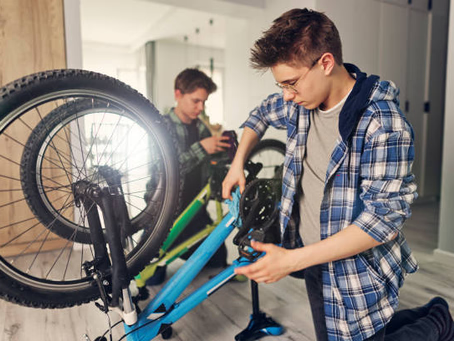
Up to age 10, children go through many different developmental stages, including several growth spurts. But at this stage, the changes are much more drastic. In addition to the height growth, which for many reaches adult stature at this time, puberty occurs with all its implications.
Until now, the child had been gaining more agility and motor skills. But now, the transformations reach another level with far-reaching possibilities and implications. And these changes awaken powerful feelings and sensations that will require all the self-control training and communion with God they have exercised and developed up to this point.
If you have any doubts about the relationship between a young child who can wait to eat at the right time and success in both adolescence and life (academic, social, romantic, and health), read the studies related to the so-called 'Marshmallow Test' (see on YouTube: https://www.youtube.com/watch?v=77XIyD0YTqU). Whoever is faithful in small matters is much more likely to be faithful in large ones. Your work in educating young children will greatly facilitate your teenager's success.
By age ten, it's important that the child, if not already, be introduced at home to the physical changes that will occur during puberty, as well as guidance on sexuality. Often, we feel unprepared for these conversations and allow our children to become familiar with the topic through friends or publications that will awaken a distorted and often perverted view of this gift from God.
This conversation begins early but needs to be expanded, deepened, and personalized as the child grows. Unfortunately, with the availability of material online, as well as the popularization and vulgarization of sex, if we do not present the divine version and protect them like eagles, Satan will implement the satanic version in their developing minds. And today, more than ever, with the acceptance of dating long before maturity and premarital sexual experience being so popularized, the pressure is in this direction. Adding this to the internal pressure of hormones and attraction to the opposite sex, we can see the importance of giving our children the protection, knowledge, support, and supervision they so desperately need to succeed.
Before this relationship with others, however, comes the interaction with a new body. As many mentioned in their responses, this transition is not always easy, and the reasons are largely social. We become different with a new body; the bone structure of our head changes, our features change. We see ourselves differently, and people see us differently and treat us differently: both acquaintances and strangers who look at us with different eyes. It's a mix of joy and a certain pride in growing up and becoming an adult, along with shyness and embarrassment.
Beyond the changes themselves, there's the problem of self-image. From a young age, children are exposed to this sexualized 'ideal' of beauty. On TV, in Disney movies, with girls' dolls and boys' action figures, the presented and repeated standard is impossible to achieve. The idealized image sold in every advertisement, shopping center, magazine, or clothing ad tells you that you are not good enough. This dissatisfaction is planned to sell the product. The side effect, however, is terrible, especially for those going through physical transformation or dealing with their new self.
Society delivers its message non-stop and in the most diverse ways. We need to do the same, repeating in different ways and exposing them to books, media, and people who share the divine vision. The world's message is artificiality, discontent, conformity, subordination, competition – evolution. Ours is gratitude, diversity, simplicity, humility, genuine and holistic beauty – creation. Our children need to see and internalize that the world's standards and trends are, in essence, a philosophy diametrically opposed to Christianity.
Our self-image needs to encompass the whole being – physical, mental, and spiritual. Our standard of beauty needs to come from our textbook – nature – with its diversity and simplicity. We need to teach our children and ourselves to value what God values and reject what He rejects.
Living in the countryside greatly relieves this pressure. Detaching ourselves from much of the media cuts off the megaphone they use to convey their message. Seeking friends who follow divine principles of not being enslaved by fashion and the world adds support for good, whether these friends are in our church or in another state. Social connection and acceptance are very important at this stage.
Knowing boys who prefer decent and natural girls instead of indecent and 'over-produced' ones, and knowing girls who are more interested in whether a boy loves God than if he has the latest haircut or is muscular, is a relief for everyone who, deep down, wants to be accepted for who they are.
Showing that we take pleasure in our children's appearance without disproportionately valuing this aspect is healthy. Teaching them to dress and style their hair with good taste and in a way that suits them, training them in good posture, and helping them to have a pleasant expression by frequently using a friendly smile, makes them attractive and inspires self-respect (which today we call self-esteem).
Our conversation should also focus more on people's inner beauty and character than on superficial aspects. Our children learn to admire what we admire.
Another thing that develops self-respect is the ability to do things well, to be good at what one does. I know a young man who learned to make beautiful and extremely well-made furniture pieces (https://vimeo.com/88203381). Another one makes professional-looking videos. He made a film of someone baking bread that turned out to be the most beautiful thing. (https://vimeo.com/32864925). My daughter made a dress for herself that turned out very well. She is learning to sew, and this gives her the opportunity to wear decent and tasteful clothes, adapting them to her style, in addition to the pleasant sense of being capable.
A colleague's sister loves to cook. Her mother spent months living in another city with her so she could learn vegan gourmet cooking. Afterward, she started making easy video recipe shows. Although she's shy, her show is funny and informative. She records, edits, and posts it herself. She's becoming famous in Adventist circles in the USA (https://youtu.be/ZaCt-HPkzzo).
Why am I talking about this? God made us to find joy in our accomplishments, our efforts. We are told that in our well-done work, we experience the same joy God felt in creation. Those who feel this divine joy have something to give; they recognize the pleasure and admiration they bring to others, and they need less of the self-affirmation that comes from something we did nothing to earn, for which we have no merit, such as physical appearance, which is so ephemeral.
We need to give our children a foundation on the rock. What God values is lasting and contributes to our growth and that of others, as well as to the family and society, in addition to multiplying and improving over time and enduring for eternity.
Every aspect of true education prepares our children to be happy and successful at every stage. The more we use its principles, the more faithfully we apply them, and the sooner we start, the easier it will be for our children to succeed in each phase of their development.
Their understanding that their body is a temple for God's dwelling, and their daily practice of putting into it only what is acceptable in terms of food, entertainment, and clothing, will have its effect when this new phase arrives. Their body will still be seen as the temple built according to the divine pattern for it, to receive His presence and reflect His glory.
Silvia Martins
Photo: Getty Images

